A Project about User-Reported Coordination in Shared Laundry Facilities
Group 24 Shuyue Cheng · Chenyang Hu · Yiting Wang Chenxi Zhang · Rongyu Zhang
PEOPLE IN THE LOOP
Yiting Wang
BASED ON HIGH WEST RESIDENT EXPERIENCES
Starting from frustration in the laundry room: Why can’t we do laundry smoothly?
Resident A 😣Guys, washer 1 & 4 have finished already. Please collect your clothes on time!
Resident B 🥀Tired of waiting for people to pick up their clothes…
Resident C 🤔Is the machine’s countdown really accurate?
Resident D 💔I was only a few minutes late. Someone took my clothes out and left them in the dusty collection basket.
One machine out of serviceA room-wide disruptionPayment-system failure reported by residents
Translated from Chinese. Anonymised for privacy.
Yiting Wang
Coordination is hard because:
Delayed collection
machine unavailable
transfer from washing to drying delayed
Moving clothes is a direct but imperfect solution
Machine status isn’t reliably shown online
Yiting Wang
OUR QUESTION:How far can credit-based allocation, reminders and collection coordination reduce queueing when machine status depends on resident reports?
Yiting Wang
Existing research approaches
The gap
Sensor Systems
Work by measuring machine states
Jo et al., 2019; Portase et al., 2024
Booking Platforms
Work with slots & notifications
Marcu & Damian, 2025; Serajudin & Mostafa, 2025
Behavioural designs
Work on incentives and shared expectations
Lam et al., 2016; Fossett, 2026
THE GAP
Coordination of the system
OUR SETTING
A system based on incomplete & self-reported information
Yiting Wang
Design
The Three-step Loop
01
Report
Scan QR code to start and collect
02
Coordinate
System allocates the queue & reminds you.
03
Correct
Found clothes in a “free” machine? Report it! The machine turns “Unknown”.
Chenxi Zhang
FROM RESERVATION TO COLLECTION
One complete laundry journey.
OPTIONALReserve a washer
ALLOCATIONCredit + waiting
Or use an available washer directly ↙
01 · SCAN TO STARTWash — 35 minRegister machine use
02 · SCAN TO COLLECTCollect & transferRelease the washer
03 · REGISTER USEDry — 5–60 minSubject to availability
04 · SCAN TO COLLECTFinishRelease the dryer
Optional linked dryer request
Report a mismatch → Check & correct availability
Chenxi Zhang
DESIGNED FOR PEOPLE
Beyond the Algorithm
Algorithms can’t solve everything.
Friendly design encourages considerate behaviour.
Chenxi Zhang
THE FIRST DRAFT
A quick flashback
A simple simulation of the LaundryLoop proposed in our first draft.
There are some major differences compared with the current design:
Users choose a time range, rank the machines and apply a day before their laundry day.
Gale–Shapley stable matching matches students to machines in the simulated time period. Each machine matches five students.
The system determines the sequence and time in which students can wash their clothes.
The reminder algorithm introduced in “Future” decides when to send “You may come down now”, aiming to maximise efficiency and make the machine very likely to be empty when the next user arrives.
Chenyang Hu
EARLY ALGORITHM EXPLORATION
Stable matching
Rank machines → Propose → Keep or reject → Match
Chenyang Hu
BEFORE CONFIRMING A HOLD
Which machines are available?
01
Fresh vacancy report
Fresh means ≤ 10 min old
02
No active session
In the applying user’s schedule
03
No conflicting confirmed hold
We can’t arrange the machine for two people
04
Machine not damaged
Reported by users
05
No uncertain state
Or disputed — almost the same here
The system predicts cycle finishing times by adding 35 minutes to the user-reported start time. A finished cycle does not confirm an empty machine: clothes may still be waiting for collection. User-sent collection signals help confirm vacancy. However, there are tricky users…
Chenyang Hu
CREDIT + WAITING COMPENSATION
Queueing rule
User 1: 96 credits + 20 minutes waited96 + 4 = 100Considered firstUser 2: 98 credits + 0 minutes waited98 + 0 = 98Sorry, have to wait>
2 additional rules:
Confirmed holds stay in place.
“Waiting time” starts from limited eligible waiting time.
Applying 22 hours earlier won’t make you have some sort of undefeatable priority
Chenyang Hu
VISIBLE RULES
Credit feedback rules
Unlike Alipay, credits and rules are transparent to users.We’re quite proud of this.
On-time scanned collection
+2
Collection over 10 minutes late
−3
Manual collection
−1
Reservation no-show
−8
Credits start at +100 and stay between 0–120. Positive rewards are limited to +4 per day.
Chenyang Hu
Two Stages
To connect the dryer:
35 minWashing
→
2 minTransfer
→
5–60 minDrying
To kill processes:
15 minHow long a confirmed hold stays valid120 minAfter this, an unsuccessful request is cleared from the system
Chenyang Hu
Future: Two extensions to help with peaks
Wait, how can I explain all these in 30s? 💡 I can just put them here.
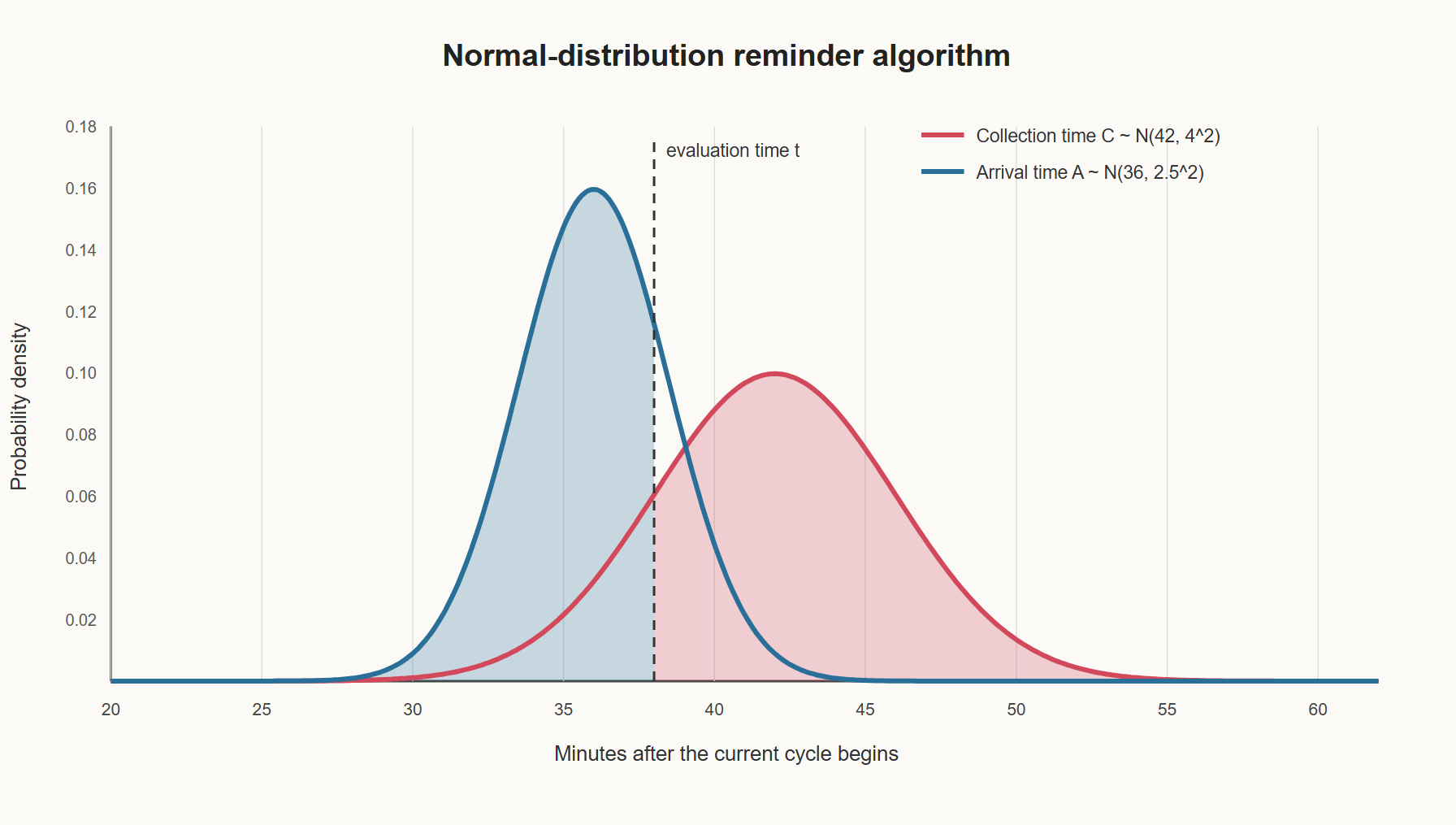
1. Earlier reminders
C ∼ N(μC, σC2)
A ∼ N(μA, σA2)
Conflict event: A ≤ t < C
P(conflict at t) = P(A ≤ t) · P(C > t)
P(conflict at t) ≤ 0.05
Tcheck = max(μC + 4σC, 36 + μA + 4σA)
This sets an upper limit to the time we search for t. If no t is found, use this upper limit.
2. Personal recommendations
S=LDemand+DDue time+HHabit+JSmall offset
S
Total score for a recommended time. Lower = better
L
Estimated pressure on laundry resources
D
Absolute distance from the estimated due time, to the end of the user’s chosen time period
H
Mismatch with the resident’s usual clothes-washing time
J
Deterministic resident-specific offsets, with magnitude ≤ 0.1, to avoid recommending the same time to everyone
Chenyang Hu
Experimental Results
Mean queueing time per completed wash-and-dry load in a simulated laundry room.